Sunday, August 7, 2011

A Very Peculiar Mystery!

I really enjoy learning about the histories of people, places and things, but the topic I am writing about today is a real stretch......way back......to anywhere from 10,000 to 100,000 years ago.   I wanted to include it here before I leave the Carolinas and go back to my travels in Oklahoma.  


The Carolina Bays


Have you ever heard of the "Carolina Bays"?  They exist, and they are probably not what you think!   The Bays are very mysterious, and there appears to be no definitive scientific explanation for them.   


I lived in North Carolina for a number of years and have visited South Carolina often.  I had never heard of the Carolina Bays before I happened upon a geology website a year or so ago that talked about them.  Apparently some people were aware that the mysterious Bays existed from as far back as the 1750's, however, the extraordinary magnitude of the phenomena was not understood until this aerial black and white photograph of the Myrtle Beach, South Carolina area was produced in the 1930s.  
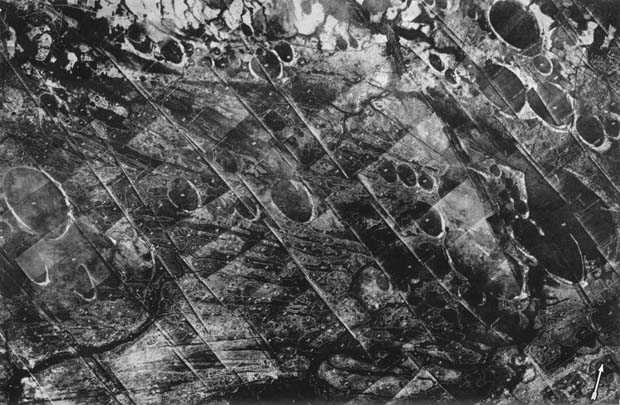

Aerial Photograph of land near Myrtle Beach, S.C.; from Cintos.org

For the first time the tremendous number of Bays, or teardrop-shaped depressions in the earth's surface, was evident.  It also became clear that these depressions were consistently oval in shape and were uniformly directional: always aligning northwest to southeast.   


The Bays shown in the old photograph above are but a tiny fraction of the total number discovered.   Research later showed that there are as many as 500,000 of these strange elliptical depressions -- all aligned in the same direction!  While they are almost exclusively concentrated along the narrow coastal range of North and South Carolina, a few fan out into north Florida, Georgia, Virgina and Delaware.   Geological formations of corresponding magnitude appear nowhere else on earth (though some have recently noted a very small number of similarly aligned eliptical ponds in the vicinity of Perth, Australia). The Carolina Bays are symetrical and shallow, not more than 50 feet deep.  They range from 200 feet to 7 miles long and sometimes overlap one another.  Some are filled with water, many are swampy, a large number are thick with varieties of bay trees (thus the name Carolina Bays), and some are dry.  Over the years many have been drained and plowed for farming or put to other uses.  


I can count at least 8 Bays in this photo


In South Carolina, the Woods Bay State Park was established to preserve the Bays in that area from destruction: 


Woods Bay State Park, S.C.


In North Carolina, one of the larger Bays is now known as Lake Waccamaw; it drains into the Waccamaw river through Conway to the coast of South Carolina.

Lake Waccamaw, North Carolina


Mysterious Origins

Over the years there has been much speculation about the origin of these strange formations.  Early on, some scientists theorized that they may have resulted from the impacts of a meteorite swarm, while others speculated that they might have been caused by a comet colliding with Earth.  Further studies have cast doubt on these "extra-terrestrial" impact theories for the source of the Bays.  No evidence of impact crater formations has been found and there have been no residual meteorites discovered in the depressions. More recently, scientists have conjectured that the Carolina Bays may be the result of some sort of natural phenomena on Earth: a series of parallel artisian springs; consistent southwest winds blowing over existing lakes; or, somehow, they were created during glaciation.  But despite years of study, there is still no consensus among  scientists as to the origin of the  depressions. 


Following is a link to an impressive YouTube video on the Carolina Bays produced by "waccamawn."  Watch it!              http://youtu.be/-vNS27eXD60

The Carolina Bays are still a very peculiar mystery!


Wednesday, August 3, 2011

Carolina "Low Country"

While vacationing in the Carolinas recently my husband and I spent a few days at North Myrtle Beach, South Carolina - a place where we vacationed with our families when we were kids.   Yes, it is a very commercialized place, but when you leave the cheesy street scene and navigate a path through a field of delicate sea oats to step out onto the sandy beach it can be marvelous.    With ocean temperatures in the low 80's and air temperatures in the high 80's in the summer you can go in and out of the water without a chill (or a neoprene wet suit like you need to wear almost all year here on the west coast). 

I love to walk.  I walk one to two hours every day near my house.  Myrtle Beach is, therefore, a perfect place for me to visit.  With 60 miles of uninterupted wide sandy beach I can walk forever, it seems.  

The Grand Strand

The coastal Low Country of the Carolinas can be, in my opinion, both interesting to visit, and quite beautiful to see.  It is not "majestic" like the mountain scenery found in the Rockies, the expansive colorful deserts found in the southwest or the rocky coastal areas of the Pacific, but it has a distinct charm about it.  There are thick pine forests patched by small farms with fields of tobacco and corn, and along the marshy wetlands there are fields of rice and meandering streams and rivers edged with giant oaks shrouded in Spanish Moss.

Tobacco Field


Intracoastal Waterway


People that aren't from the area may not realise that there is a continuous waterway route along the entire eastern seaboard of the United States.  This Intracoastal Waterway allows travel by boat from Maine to Florida without having to enter the Atlantic Ocean.  Mostly a natural waterway originally used by the Indians,  canals (first conceived by George Washington) were constructed in places along the route to make it continuous.   This waterway has played a roll in the past securing safety for our boats from naval attacks,  and, to this day, ensures safe navigation for commercial and private vehicles from the rough stormy seas of the Atlantic Ocean.


From Pawley's Island, S.C.  - looking over to the mainland

Beaches in the Carolinas, including North Myrtle Beach, are found on a series of narrow barrier islands.  A large part of North Carolina's Atlantic seaboard is comprised of the Outer Banks strip of islands reaching far out into the Atlantic Ocean.  Included in the Outer Banks is Roanoke Island, site of the first English settlement in America.   South Carolina's barrier islands, on the other hand, hug the coastline.   If you step back from the beaches and travel to the inland side of the islands you see beautiful, picturesque marshes and waterways stretching back over to the mainland.   These are excellent places to go "crabbing" and are home to oysters, shrimp and other sealife.   


Calabash, N.C. 

Now I want to go back...


Wednesday, July 27, 2011

The Carolinas - Another Detour

Just thought I would share:


While vacationing in the Carolinas  (North and South) I recently took a peaceful walk along a beautiful river's edge in Conway, South Carolina.

Thursday, July 21, 2011

Bayou Detour


Oklahoma was first discovered by Europeans in the 1540's when Spain sent Coronado to search for land and gold in the New World, but the French actually started settlements there.  The land was claimed alternately by both Spain and France in the centuries that followed, only to be handed over to the U.S. government as part of Thomas Jefferson's Louisianna Purchase agreement with Napoleon in 1803.   To protect this investment, a string of Forts were built by the U.S. military, the names of which are familiar to me from news stories, history books and Western movie scenes: Fort Smith, Fort Gibson, Fort Arbuckle, Fort Washita, Fort Cobb, etc.  

digital.library.okstate.edu

Assigned to these Forts were men who also have well known names, such as:


                                                                Zachary Taylor,

White House Portrait
Robert E. Lee,                                                                                              and, Jefferson Davis

R.E. Lee; mcwm.org
J. Davis, courtesy sonofthesouth.net


It has been a while since I've been in a history class, and, upon reflection I am not surprised,  but I don't think I have ever really thought of my home state as being part of Louisianna before:

Storiesofusa.com 

Enough of this detour for now...


Thursday, July 14, 2011

Oklahombre Outlaw

Mr. Neal Higgins recalled another interesting encounter at Sloane's  store not long after he settled in Guthrie, and many years prior to his tragic Babbs Switch experience as the Undertaker.    While working alone one night in the furniture store he said the Deputy U.S. Marshals showed up.  They told him they had a man's body in the wagon outside which they had brought in from near Stillwater, a town about twelve miles away.  Higgins went out to the Marshal's wagon to retrieve the body and discovered the man was riddled with gun shots.    Higgins said he counted "21 buckshot wounds in his breast."   It turned out the dead man was a notorious outlaw that had terrorized banks, railroads, and stagecoaches in both Kansas and Oklahoma.  The body was that of the infamous outlaw Bill Doolin!   


Bill Doolin had not always been an outlaw.  Born to a sharecropper in Arkansas, he made his way to the Cimarron and Arkansas rivers area of Oklahoma Territory as a young man and was hired on as a cowboy by Texas ranchers.   There are many reports that he was a good and reliable cowhand.  


Ganging Up


On the Fourth of July, 1891, Doolin was in Coffeyville, Kansas when a shootout took place between lawmen, Doolin,  and his drinking buddies.  He escaped from town that day and was on the run as an outlaw ever since.  He took up with the legendary Dalton Gang robbing trains and  banks, but in 1892, while again in Coffeyville, most of the Dalton Gang was gunned down after a failed attempt to rob two banks in town. 


Members of the Dalton Gang in Coffeyville
Rumors are that Doolin was there in Coffeyville at the time of the gunfight, but escaped along with one of the Dalton boys. 


Wild Bunch


Bill Doolin then formed his own gang, the Wild Bunch,  which became one of the most notorious of the territorial West at that time.  The Wild Bunch gang, also known as The Oklahombres, traveled throughout Kansas, Arkansas, Missouri and Oklahoma Territory robbing banks and holding up trains and stagecoaches.   Doolin, himself, was well liked by many of the settlers in the Territory which probably accounted for his ability to escape capture for so long.  


Bill Doolin
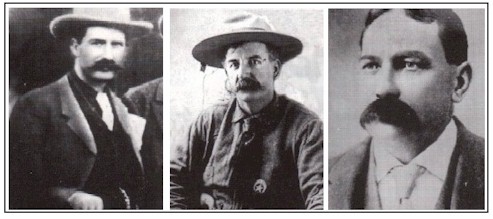
Lawrence Block, in Gangsters, Swindlers, Killers and Thieves,  describes the Wild Bunch as having good relations with the homesteaders, and identifies two women, Annie McDoulet and Jennie Stevens, also known as "Cattle Annie" and "Little Breeches," who even acted as spies for the gang members.   Doolin, himself, was  known as a family man during this time since he had married and started a family with the daughter of a Methodist minister.  


In 1896 Doolin was tracked down in Kansas and captured  by Deputy U.S. Marshal Bill Tilghman who took him to Guthrie to be tried. Lawrence Block reports that Doolin was actually taken on a tour of the town of Guthrie and allowed to shake hands with the hundreds of citizens who had come out to see him before he was locked up in the jail.  There was a $5,000 reward for the capture and conviction of Bill Doolin.  Tilghman never collected on this, however, since Doolin and some the other prisoners managed to escape from the Guthrie jail before he could ever be tried.  


Doolin successfully hid out with his wife and son at their home near Lawson, Oklahoma for a while, but Deputy U.S. Marshal Henry "Heck" Thomas and his posse tracked him down and killed him in a gunfight just outside their home. 


Three Guardsmen: Bill Tilghman, "Heck" Thomas, and Chris Madsen
usmarshals.gov
The Undertaker


Heck Thomas must have been the Deputy U.S. Marshal that brought Doolin's body to Neal Higgins in the store that night in Guthrie.  Higgins said that word of Bill Doolin's death spread fast and a mob of people rushed to the furniture store to see the outlaw.   He said "they climbed on tables or anything to get a view of the desperado."  To accomodate the viewing (and probably save the furniture, as well), Higgins said they moved the body to an empty building down the street.  Higgins was assigned to stay there with the body.  He remembered that not all of the viewers were curiosity seekers.  He had many friends and neighbors that also came by.   Doolin's wife and son still lived nearby and came to see him while he was on display.  Higgins said she wanted a picture of him, so they stood the body up and took a picture of his body for her.


A. Meier; cosmicautumn


He was buried three days later in Summit View Cemetery in the town of Guthrie, Oklahoma.  


Monday, July 4, 2011

Undertaking

Traveling from North Carolina in 1891, Mr. Neal Higgins eventually settled in the town of Guthrie, Oklahoma, working  as a part-time furniture salesman - part-time embalmer for Mr. W. L. Rhodes.   Guthrie,  which originated with the famous Land Run of 1889 into  Indian Territory, was settled by almost 10,000 people within only six hours time.   The furniture business was good, according to Higgins, since most of these people brought very few pieces with them to the Territory and they eventually needed to furnish the homes which they built.

Land Run of 1889

Higgins said he also did a lot of embalming early on.  He charged $50 for the procedure, which was generally done in the person's own home.  It was customary for someone to "sit up" with the deceased for one or two nights before they were buried or shipped back home to relatives.  His boss's wife didn't like this custom and insisted that no one sit up for her when it was her time.  When Mrs. Rhodes did die, Higgins said, the family caused quite a scandal in town by honoring her wishes and leaving her "alone" in the front room during the night.

Higgins believed his early embalming jobs were of the highest quality.  He noted that he had used "Mill's and Lacy's Embalming Fluid" in the early days, which resulted in bodies that looked alive.  In later years,  he had to use fomaldehyde.   While formaldehyde gave poorer results,  he said "patching up" the dead was better  than in the past.  Of the early days, Higgins said  "If a man had a bullet hole, we filled it with wax, but it was almost  white and showed up plainly."

I don't know which method Neal Higgins used when he was called to Babbs Switch Christmas Day, 1924.  Being the only undertaker in the area, he made the trek to the tragic site.  He said he was able to take 24 of the bodies from the school house fire in "one load" in his hearse.   The others, he said, were loaded on a truck that followed him up the road to the town of Hobart.   "That was the most tragic experience I ever went through," he said.


Hearse.com:  1920 Lorraine Hearse


Mr. Higgins had many other "undertakings," a couple of which are interesting to recount.   One rainy night he said he went to Downs, Oklahoma to embalm a woman's body.  He loaded her in his hearse  to bring her back to Guthrie, while her husband and his young helper followed behind on the muddy road.  His hearse, however, overturned on a slippery hill that night.  The man and the boy refused to get out and help him.  He ended up wading up the muddy road for about three miles to get a local cowboy and his sons to help pull the hearse back up on the road with their horses.

Higgins also recounted that they kept the body of one man for six months in the furniture store while they waited for relatives to come claim him.  He had been killed in a saloon fight in town.   They knew he was from somewhere in New York, so they placed ads in the New York papers and waited.  The furniture store was so crowded, that Higgins said he ended up having to stand the man up in the corner while they waited for someone to come claim him.   (That must have made shopping for a new table or sofa totally delightful!)  There was a law that bodies had to be buried within six months, so he took him down from the corner and buried him when his time was up.   Lo and behold, it wasn't but a month later that the man's sister contacted them inquiring about the advertisement.

Thursday, June 30, 2011

Ashes to Ashes, Dust to Dust

Heading south from the town of Hobart my family would have looked out upon miles and miles of prairie farmland in every direction.    Soon, though, we would have come upon a break in the roadway with a   turn-around driveway leading off to the left.    At the end stood a sturdy red stone marker.  I don't know if we would have stopped to read the marker, but knowing my dad, there is a good chance that we did.    This marker, which is still there, tells the sad story of a one-room school house which had once stood on that spot in what was once  the community of Babbs Switch, Oklahoma.  Neither the School House nor Babbs Switch can be seen there now.


from  E. Taylor @ rebelcherokee.labdiva.com


There are many stories and newspaper accounts of this 'town that is no longer there,' including a popular children's book The Babbs Switch Story, by Darleen Bailey Beard.    On a snowy, cold Christmas Eve in the year 1924 the people of Babbs Switch all gathered at the school house for the annual Christmas program.  Typical of that time, the building was a one-room school house.   It had been damaged by the strong prairie storms in the years past, so the community had fixed up the building with fresh paint (thinned with turpentine) and strong screens to seal the windows from wind damage.   


About 200 people from the extended community crowded into the school house for the program which, of course, included both Santa and a Christmas tree lighted with holiday candles.  Toward the end of the program Santa apparently caused one of the candles to ignite a tree branch.  The tree was knocked over in an attempt to extinguish the blaze, which, instead, caused the fire to spread rapidly.   Terrifying panic took over the crowd and people rushed to the only exit.  The door, however, opened inward so the push of the crowd prevented the door from opening fully and trapped many folks inside.  The strong screens prevented attempted escapes through the windows.  In the end, many people were severely injured and burned, and a total of 36 people lost their lives that evening as the building burned to the ground.  


The survivor's stories are harrowing.  Some say that the jammed doorway was filled with only the hands and heads of people trying to escape the inferno.  People were seen pleading for help at the windows, but the strong screens prevented escape.   It was reported that one family of four, the Coffey's, calmly formed a tight circle in the center of the room.  Their burned bodies were found wrapped arm in arm the next day.  One engaged couple were planning a Christmas wedding the next morning.  The prospective groom was instead being treated for severe burns Christmas day, while his bride was being buried in a mass grave.   


blogoklahoma.us:  The Oklahoman, December 27,1924


Injured survivors were rushed to nearby Hobart for medical treatment, but the tragedy continued.  Most people had taken the common precaution of draining their car radiators to prevent them from freezing while they attended the program.  Their cars, as a result, overheated along the roadway to Hobart's medical facilities, complicating the rescues and delaying treatments.


School House Safety


The Babbs Switch fire did have a positive consequence in the end.   The story of the tragedy in this tiny town swept the the entire nation as well as the state.   Oklahoma's Governor together with the State Fire Marshall launched a campaign to improve fire safety at all school houses and public buildings.  The result was a nationwide requirement that all doors on public buildings open to the outside,  and steel netting was banned on all school house windows.  Additional safety regulations were also adopted, such as a prohibition of candles on trees and the requirement that there always be more than one exit on buildings.