Tuesday, November 1, 2011

Stealing Tracks and Trees

While taking this trip on the internet I have been reminded how pivotal the railroads were in the development of many parts of the western U.S.   Being selected as a station location gave a town key economic advantages.  Mountain Park, the community my family would have entered next on our trip down U.S. Highway 183,  provides an example of this influence of the rail lines.   The town, which has a population of just over 400 people now, started out as a trading post for the cowboys and Indians in the area.

At the turn of the century Oklahoma City & Western Railroad made plans to bring their track through Mountain Park.   They were building the Oklahoma portion of the rail line that would go from Oklahoma City to Quanah, Texas.    A resident, Sol Bracken, was offered a deal for his property.  The OC&WR offered to pay him $6,000 for the rights to a portion of his land in Mountain Park.   They had envisioned constructing a depot in this spot.  There were already 48 businesses operating in the town which would help make the depot profitable right away.   Mr Bracken, unfortunately, saw an opportunity for himself to profit, and decided to hold out for more money for his strip of land.  The Railroad didn't hesitate.  They  immediately changed their plans and and decided to bypass Mountain Park altogether.   Instead, they moved the track line a few miles south of Mountain Park and then built their depot in the nearby community of Snyder.


Snyder Train Depot


It is clear Mr. Bracken's greed was not very popular in town: all but 7 of the businesses packed up, left town and moved their operations to Snyder instead.  The first business to set up in the new town was a saloon.  According to E. Taylor (rebelcherokee.labdiva.com) the people of Mountain Park became so upset at the mass migration they actually burned the bridge that was on the road to Snyder.   

Although the town of Snyder flourished, its early fortune was not all positive.   Businesses boomed and the population grew, but in 1905 the town was hit by a devastating tornado.    Newspapers reported that 113 people were killed by the twister.  Additionally, about a year later Snyder was razed again by the first of two massive fires that attacked the town.  Businesses in town were rebuilt with fire-resistant brick after the 1909 fire.

Mr. D. Thomas homesteaded on land west of Mountain Park and Snyder.  His interview in the University of Oklahoma's Western History Collections (#4479) tells of the handicaps and hardships he and his fellow homesteaders encountered at the turn of the century due to the scarcity of fuel.   Because wood was so hard to find he confessed he would steal it from the Indians.   "Practically every pioneer has been guilty of stealing wood at one time or another whether he is willing to admit it or not," he said.   He went on to describe something he had posted in a newspaper years later: "I made certain remarks about certain rabbit eating, wood stealing pioneers and their early day escapades..." He continued, "I was surprised when the phone rang and an old lady informed me that she had just read the article and was offended at the remarks concerning her husband.  She screamed, "What will our children think when they read that we used to steal wood?  The trouble is that it's---it's so!"  He went on to reflect, "How else could this country have been settled up?"


H.F. Farny:  Toilers of the plains


Friday, October 21, 2011

Boys Will Be Boys

When I first looked at this week's Sepia Saturday prompt I thought I was seeing a group of girls and boys together on a class outing.   I thought I would dig up some photos of my mother as a teacher in the 1940s,  or perhaps re-post a photo of my great grandfather with his students outside their one-room schoolhouse at the turn of the century in Oklahoma Territory (see my September post More Schoolin').  On further inspection, I realized that I was looking at a group of only boys.  There were no girls here.  The boys were, however, all costumed in outfits that give the appearance of  girls' dresses or overcoats.      Perhaps these outfits were not in fact  girl's clothing, but were instead some type of ethnic or local costume for boys.   Whatever is the truth, it is clearly evident to the viewer that  these adorable boys were absolutely delighted and amused at their circumstance.  Looking through the door behind them I see what appears to be a window styled like one would see in a church.  This leads me to the theory that these young men were all participants in a boys choir group at their local church and had just concluded their performance - to the great relief of all!  I wonder what songs they sang?  The choir director must have been relieved at their success as well - and proud enough to record the big event with a delightful group photo.

I remember as a child seeing the Vienna Boys Choir in concert when they went on a tour of  the United States.  They were absolutely marvelous!  Their crystal clear voices rang out in the concert hall with harmonies and soprano notes I had never heard before.  It seemed that they must have trained their entire lives to perform so well.  And, to my amazement they were able to do this in front of such a huge crowd!   I must confess that in addition to enjoying the music, my sister and I spent some of our time pointing out the boys to each other that we thought were cute.  


This brings me to my Sepia Saturday submission for this week:

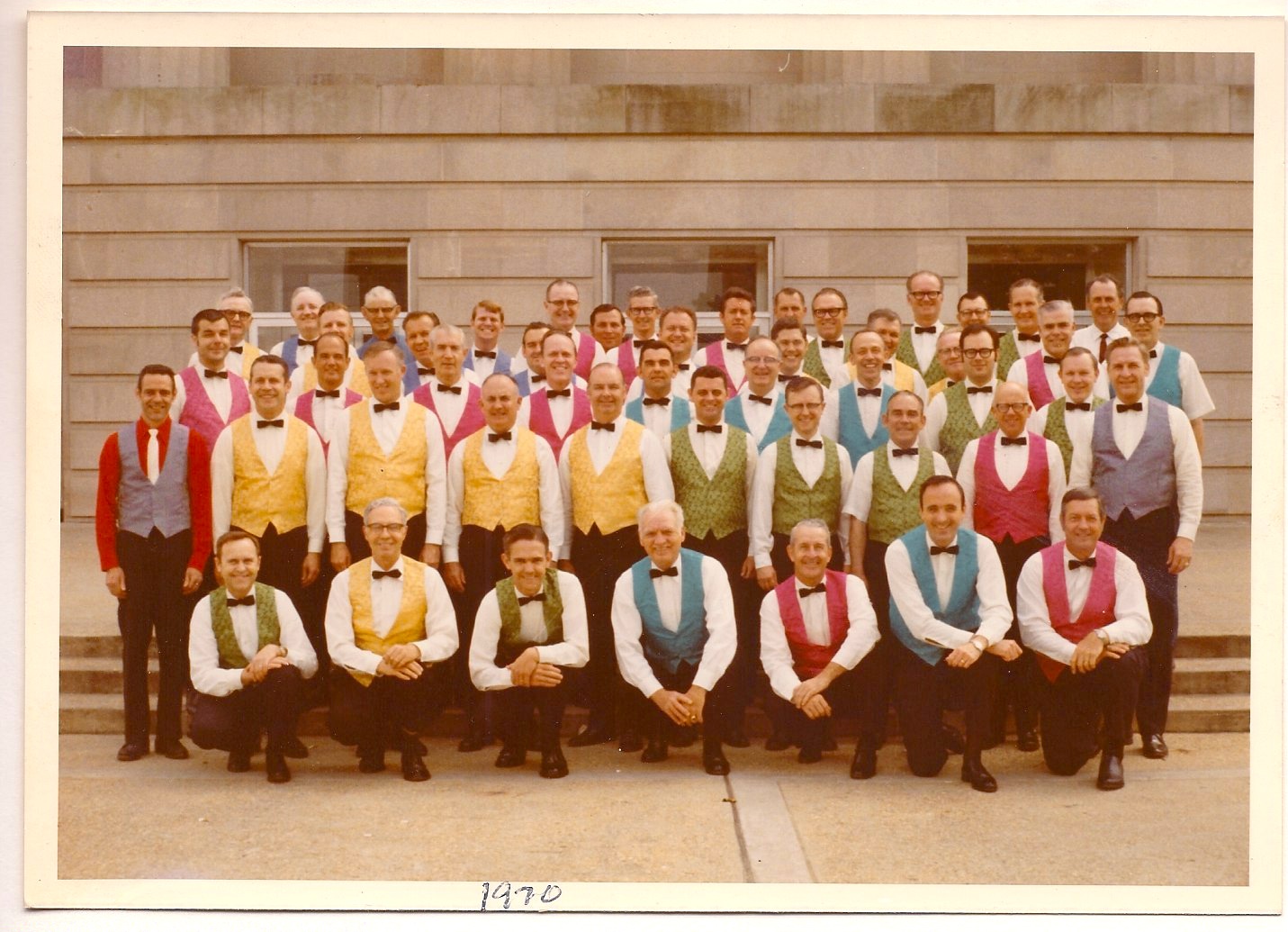
My Dad's Barbershop Chorus

About the time I was in high school my father decided to join a local men's chorus. I can't say he was a good singer, but he loved music and he loved people. The chorus provided him an opportunity to enjoy both of these one or two evenings each week.   I, like the rest of my family, was quite proud of him for doing this and wished him well in his new hobby.  We all planned to attend the concert his group would be giving in the city's performance hall in the Spring.

Then a terrible thing happened.  My father invited my friends to come to the concert!  

I knew my dad's chorus sang in Barbershop-style harmonies.   You wouldn't find Barbershop songs on any of the lists of "top 100 hits"  my friends and I listened to.   I have blocked what I may have said to my father from my memory, but I am certain I must have shed a few tears.  I was so embarassed about what my friends would think.

When the dreaded day finally arrived I joined my friends in their car to head down to the performance hall.  I must have said "You don't have to like it, you know" to them a hundred times on the way there, and, of course, we looked for seats as far to the back of the hall as we could.  When the curtains opened and the chorus of men sang out in their ringing consonant harmonies we were bowled over.  Of course they sang the songs you would typically expect from a Barbershop chorus: Down by the Old Mill Stream, Sweet Adeline, and Wait 'Til the Sun Shines Nellie, but they added in many other songs to their repertoire.  There were songs that my friends and I actually knew and listened to such as Yesterday by the Beatles.   We found it to be a really fun and unique experience, and talked about the concert (among ourselves of course) for days.   

Much like the boys choir in this week's Sepia Saturday prompt, my dad's Barbershop Chorus lined up outside the performance hall when their concert was over.  They were all clearly quite happy it was over, and they were also quite proud of their accomplishment.  I was too.

Wednesday, October 19, 2011

Golden Buckshot

There have been tales of treasure in southwestern Oklahoma ever since it was known as Louisianna.  Explorers and miners have been searching to find this treasure throughout the years.   During the time it was Indian Territory some soldiers stationed at Fort Sill complained that they had more trouble keeping prospectors out of Oklahoma than they did fighting the Indians.  There were apparently strong rumors of gold deposits in the area where we drove south out of Roosevelt along Middle Otter Creek.  When the Kiowa-Comanche-Apache territory opened up for settlement in 1901 prospectors rushed here.  According to the site goldfeverprospecting.com thousands of claims were filed and multiple shafts and smelters were constructed during the first decade of Oklahoma Territory.  It turned out only a very few pockets of ore had high assay values, however,  and the prospects for riches quickly faded.

Gold Belle Mining and Milling Company was a cyanide processing mill built to process the miners' ore from the nearby prospectors' town of Wildman.  Today only remnants of the foundation exist just west of where we traveled on U.S. Highway 183.

Gold Belle Mine and Milling Co. marker (courtesy blackiron_1 photostream)

Frank Wildman, one of the partners that formed Gold Belle Mine, was also the namesake for the nearby mining town of Wildman that sprang up at the Territory's opening.  There were almost 500 people living in Wildman which had a hotel, saloons, a hardware store, grocers, a cafe and other offices, ..... but no church.  E. Taylor (rebelcherokee.labdiva.com) sites newspaper reports that tell of a man showing up in the neighboring community of Mountain Park at about this time wearing a gold pin shaped like bells.  He claimed they came from the Gold Bell mine he was working and was offering to sell shares of stock.   The sign that is now standing at the mill site says the owners salted the mine by blowing gold dust into the walls with a muzzle loaded shotgun.  They then sold shares of stock in the mine for a dollar a share netting them about $270,000.  The newspaper cited on E. Taylor's post also shows the quote of one man from the area who recalled that the only man who made money out of the mine was the hardware store merchant who had sold all the machinery to the miners!  The Gold Bell mine was abandoned in 1910 and the town of Wildman has since disappeared.


Saturday, October 15, 2011

Making War Fun

I spent untold hours the last few days going through boxes of old photos and memories my parents have left behind.    I didn't know what I was looking for specifically, but I knew I would find something that would match the inspirations I received from this week's Sepia Saturday photo.   In surveying this week's prompt I saw a group of soldiers gathered together on the remains of a war torn battlefield somewhere far away from home.  Captive to their circumstance, these men, it appears to me, were searching for a reason to celebrate with a smoke and a meal.

My father, like many young men during World War II, joined the Navy not long after the Japanese bombed Pearl Harbor.   Anxious to do his part,  he was frustrated initially because he was kept stationed stateside in Virginia and Maryland.  I remember him saying he was thrilled to finally "participate" when his ship, the USS Sumter, finally set sail for the battlefield.   The USS Sumter was commissioned as an Attack Transport.  My father was a Pharmacist Mate in the Hospital Corps for the ship which transported soldiers to most of the major battle theaters of the Asian and Pacific Campaigns.   He tried to take photos during the two years he was assigned to the ship, (some developed in x-ray fluid) a few of which have survived.  One of these pictures has become my submission for this week's Sepia Saturday post:


Soldiers and native Islanders on the Kwajalein Atoll, Marshall Islands WWII  

These men, like the prompt photo, were also searching for a moment of joy while confined to a battlefield far away from home.   Curiously,  in both pictures there is a single soldier staring directly into the camera.    They each appear to be reaching out to the viewer with an expression that seems to question the meaning of this joy or purpose of their circumstance.  

Kwajalein is located in the center of the South Pacific's Marshall Islands, and is the largest coral atoll in the world.


The Japanese had built defenses in the Marshall Islands and used them as staging sites for submarines and surface warships.   Admiral Nimitz decided to launch an attack on these defenses which he called "Operation Flintlock".  The Army's 7th Infantry Division along with the 5th Amphibious Force and the 4th Marine Division participated in this successful attack on the central island, Kwajalein Atoll.   Some of these  men must have been transported to the battle site on the USS Sumter, and certainly many of the wounded were brought back to the Sumter's Hospital Corps for treatment.   In the end, 372 Americans died and almost 1600 were wounded in the battle, while the Japanese lost 7,870 men.


Please enjoy the many other posted submissions to this week's Sepia Saturday site!

Wednesday, October 12, 2011

Rock Climbing the Great Plains

The Great Plains region of North America is generally defined as the sweeping region of steppe and flatland covered with tall and short prairie grasses.  It ranges from the Mississippi River west to the Rocky Mountain foothills, and from the Mexican border north into the Canadian provinces of Alberta, Manitoba and Saskatchewan.   It has been the broad expanse of land where  massive herds of bison ranged, where Native Americans hunted and where pioneer families eventually came to settle.    The lands of western Oklahoma lie within the Great Plains borders.


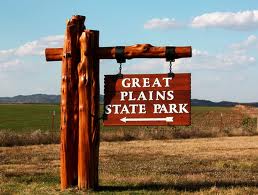
Therefore, heading south from Roosevelt on U.S. Highway 183 it comes as no surprise for travelers to see the sign signaling an exit for Oklahoma's "Great Plains State Park."


Although I doubt my family would have taken this detour on our trip south from Sentinel  I did take a few minutes to explore this park on the internet.   The park apparently offers many great opportunities for exploration, camping and outdoor activities.  It has accumulated many positive reviews from visitors.   I found it curious, however,  to learn that despite its name it is not a park where one goes to enjoy the plains' vast prairie grasses.   Instead, Oklahoma's Great Plains State Park offers camping, mountain biking and rock climbing in the "rough rocky terrain" of the Wichita foothills as well as water skiing and fishing on a large man-made lake!

Great Plains State Park, Oklahoma
 It looks like a wonderful place to visit but I must say I am more than a little confused about its name.

Friday, October 7, 2011

Home Economics

This week for the first time I have decided to participate in Sepia Saturday.  I have been following the Sepia Saturday posts by others for quite a while after being introduced to the site on one of the blogs I follow: Robs Webstek Historybits.  While I had hoped to look through my old family photos and find pictures of my female ancestors participating in suffrage parades, or something equally significant, it was not to be.  Perhaps there were no such activities for women in the small, rural towns of  South Dakota or Oklahoma.  I can't imagine that the issues were not important to these women.  I know that education of both men and women was of the highest importance in my family.   The papers and documents that have been preserved make it clear that everyone was acutely aware and interested in issues of national importance and world affairs.  My mother was college educated in the 1930s which, although not unheard of, was not entirely common among her peers at that time.   During WWII she actually left home to work for the FBI in the big cities of Chicago and Washington D.C.   I expect that she may have been a participant in these parades had she been of age at the time.

The most relevant picture to Sepia Saturday's prompt that I could find in my files was one of  my mother and her  female high school classmates "holding signs":

Lennox High School, 1935

The signs that these girls were holding, however, were not signs for women's voting rights, but were signs to promote the importance of "home economics" for girls.  The girls are holding fabric samples, a cake, needlework and have what appears to be cages with live chickens  in front of them.  My mother is the girl in the plaid shirt and dark skirt holding a small sign just left of center.   

Hmm...Home Economics.  I had a home economics class while I was in junior high in the 1960s.  The girls went to Home Economics while the boys went to Shop class.   I don't remember much about the class except that we made brownies and sewed an apron (which I still own).   Home Economics was not a subject offered to my daughter at any time during her school years.   While I am very happy that she and her generation of girls see the world as having a much wider spectrum of opportunities than perhaps mine or my mother's did, I am also very sorry she was not given more information about how to "run a home."   She is away at college now.  My husband and I are constantly reminded, and I think it is also becoming clear to her now, that she has almost no clue about how to fix a healthy meal or balance her bank account  or replace a lost button on a blouse.  I know full well that this knowledge will eventually come to her, but it is really hard for us to wait for it!

Thursday, October 6, 2011

My Apple

I love my iPhone, my iPad, my iPod, my desktop computer, my laptop, and I love Pixar movies!


Courtesy: digiGroup.us